Thank you! Your submission has been received!
Oops! Something went wrong while submitting the form.
By combining truly personalized science with artificial intelligence, we can predict how effective different treatment options would be in battling your dog's cancer.


Every patient is unique, so two patients with the same medical condition may respond differently to the available treatment options. Precision medicine is an emerging approach for improving the success rate of medical interventions by identifying the treatment options most likely to be effective for individual patients.
What is functional precision medicine?
Functional precision medicine is a strategy in which live patient cells (such as tumor cells) are directly exposed to various drugs in a laboratory to observe their real-time response, providing personalized data to guide the most effective treatment for that specific individual.
Our approach is “functional” because we directly test how effectively anticancer drugs disrupt the normal functioning of a patient's live cancer cells. ImpriMed’s approach to precision oncology is unique in several ways.
The result is a unique precision medicine product that enables you and your veterinarian to quickly find the best drugs for treating your pet's cancer.
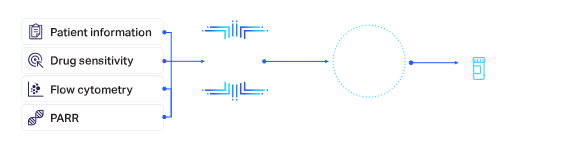
How do we get live cancer cells to the lab for testing? This is a real challenge for most companies. The logistics associated with keeping cells alive long enough to be tested are difficult to overcome.
ImpriMed innovated past these challenges by developing a proprietary transport medium that keeps cells healthy during shipping and a web portal to make ordering, processing, and receiving samples easy and fast.


Drug sensitivity shows us how effective a drug can be for each patient. Our drug panel currently includes 13 anticancer drugs that are commonly used for treating canine lymphoma and leukemia.

Flow cytometry quantifies the levels of 10 different proteins found on and within tumor cells. This test provides prognostic and diagnostic information for leukemia and lymphoma.

PARR (PCR for Antigen Receptor Rearrangement) tells us the genetic lineage of the malignancy. This test lets us give veterinary oncologists detailed information about the expansion of B-cell and T-cell clones.
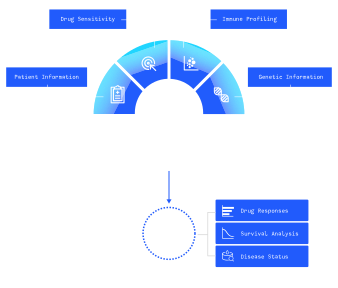
To determine which drugs elicit a positive clinical response, we conducted an initial study to collect real-world data. We used the data from this clinical study to train AI models so they can predict the ways in which individual patients will respond to a panel of commonly used anticancer drugs. After the initial clinical study, we partner with our amazing network of customers to continuously grow our database of clinical outcomes. These data are added to our existing database and used to further refine the AI models.
Our outcomes database now includes more than 2,500 canine patients and is growing by the month. Due to ImpriMed’s continuous learning process, our AI models are constantly increasing in accuracy with more time and more customers.
Based on our established technology and workflow, we performed clinical studies to evaluate correlation between our predictive value and the actual clinical response to various anticancer drugs.


